December 01, 2005

ACCA


The Association of Chartered Certified Accountants (ACCA) is one of the leading accountancy professional associations in the world. This is the largest and fastest growing international accountancy body in the world, with over 320,000 members and students in 160 countries. The ACCA has an extensive network of over 70 staffed offices and other centers around the world.
Brief History:

In 1904 eight people formed the London Association of Accountants, in order to provide opener access to the accountancy profession than the two existing accountancy organizations. The ACCA went through a number of mergers and amalgamations over the years. In 1984 it became the Chartered Association of Certified Accountants to reflect the fact that, a decade earlier, it had been granted a Royal Charter of Incorporation. In 1996 ACCA became the Association of Chartered Certified Accountants (ACCA).
About the Association:

The ACCA members, who are known as Chartered Certified Accountants, are employed in the industry, the financial services, the public sector, or in public practice. With statutory recognition in the UK and Ireland, ACCA has the authority to license their members to work as registered auditors. In the UK, it also authorizes its members to undertake in solvency work. Outside the UK, ACCA are recognized under the EU's Mutual Recognition Directive and in many countries around the world.

In Bangladesh, the demand for the ACCA qualification is also increasing and a few fully qualified persons are in service in different sectors. Now British Council has become a regular exam centre. People who are interested in the profession and want to use the opportunity to join their desired career they can register themselves online at the address:
www.accaglobal.com.

In other South Asian countries such as Pakistan, India, Sri Lanka and Nepal, the ACCA is a recognized qualification and its demand there is very high compared to Bangladesh. By recognizing the ACCA, the business as well as the education sector is benefiting in these countries. To get the full benefit, our business sector must realize the value of this qualification. And accordingly, it has to act by recruiting more and more qualified ACCAs. If we can create more and more opportunities for our professionals, then the students, who had gone to UK to earn this qualification, will be back and the country will get better service from this fresh crop of experts.

In the UK, the difference between the ICAEW and the ACCA in relation to the job market is very little. From the salary survey, it is clear that there is no difference. Members of both the associations can engage in general practice in the audit and solvency practice. The ICAEW member can get the ICAB membership straightway, but not the one from ACCA. In our view this is not fair. We would appreciate if the ICAB authorities can sit on this issue and discuss the matter both within ICAB and with ACCA. If we can include ACCA in our list, we believe we will be benefited. Since ACCA is the most dynamic and active association, its members are in every sector of business and consultancy.

The goal of the ACCA is to be the leading global professional accountancy body in size, influence and reputation.

ACCA's Mission:

> To provide opportunity and access to the people of ability around the world and to support our members throughout their careers in accounting, business and finance;
> To achieve and promote the highest professional, ethical and governance standards;
> To advance public interest, and
> To be a global leader in the profession.
Strategic Approach:

In 2004, ACCA's's strategy, plans and operations were reviewed. As a result of this work, the ACCA's Council agreed on a new corporate strategy.

In summary, the ACCA Aims to:

> Be the first-choice qualification to people who seek a rewarding career in accountancy, finance and management
> Provide distinctive, world-class qualifications, which secure opportunity for our students and members
> Enhance relationships with employers, governments and other key stakeholders that will help sustain demand for ACCA-trained professionals
> Retain member loyalty, encouraging members to become ambassadors to increase ACCA's influence; and
> Use our expertise to assist organizations to develop the profession.

To support this strategy, the Council has agreed on a range of key performance indicators, which will be used to measure progress against specific objectives. These cover growth, stakeholders' satisfaction and retention, efficiency and innovation. The ACCA will report annually on its key performance indicators. Both Council and the executive are committed to demonstrating accountability, providing value and developing the accounting profession.

The ACCA's Strategic imperatives are to:

> Continue focused growth, concentrating on core products and services
> Build and leverage our global infrastructure and reach;
> Engage our large and growing membership base, and
> Create a more efficient and effective organization.

For our own improvement and benefit we should recognize the ACCA qualification and take necessary steps to recognize any ACCA member. In this way, we will get more experts for our association and improve ourselves further from their service.

November 30, 2005

Tata Investment


Militancy won't rock investment plan: Tata

Top executives of Indian business giant Tata yesterday said the recent rise of militancy in Bangladesh won't discourage them to go ahead with the planned $ 2.5 billion investment as terrorism is now a global problem.

"Terrorism is now a global problem... London is affected, New York affected, New Delhi too. This problem here will not affect our investment," Alan Rosling, executive director of Tata Sons Ltd., told reporters in the city.

His comment came when journalists drew his attention to the matter shortly after a press conference where he elaborated the findings of the Economist Intelligence Unit (EIU) on economic impact study of Tata's investment in Bangladesh.

Rosling said he is hoping to see one or two key people in the government shortly to sort out a timeframe for resuming fourth round of negotiations on the investment in power, steel and fertiliser sector in next couple of weeks.

He claimed positive outcome in the past meetings, but said the outstanding issues remained to be resolved, including fixing tariff for gas it will purchase and electricity it will sell, gas security, land acquisition, coalmine leasing and fiscal incentive.

He replied in negative when asked if they had any discussion with the opposition on the proposed projects.

"We are discussing with the government and if people of Bangladesh change the government after one year, we believe the successive government will honour the deal. It'll be a deal between Tata and the Bangladesh government," he said.

"This is an unprecedented investment proposal in whole of the South Asia, not only in Bangladesh. Nobody took forward an about $3b investment proposal before," he said.

Replying to a query on cross-border energy trade, Rosling clarified that they are not here to export electricity or gas. "We are here to purchase your gas for generating electricity and setting up world's largest urea fertiliser factory."

Dhaka Stock Exchange 1


DSE moves to expand inter-district trading of stocks

Inter-district trading of stocks is going to be expanded with the broadening of the wide area network (WAN) automated system as Dhaka Stock Exchange (DSE) hopes for a significant rise in its daily turnover. Currently, the average monthly DSE turnover is Tk 4.00 billion in value, but with such expansion, the main bourse expects the figure to double within next few months.

"We are optimistic about a surge in our business as our members are going to start their operations in Sylhet, Barisal, Rajshahi, Comilla, Rangpur and other parts of the country," one DSE director told. The DSE director said the number of individual investors will hopefully increase by around 50,000. Currently, there are about 0.2 million individual investors in the country's stock market.

DSE has already started online stock business in Chittagong through LankaBangla Securities, a member of both DSE and Chittagong Stock Exchange (CSE). The DSE move on business expansion was taken in view of an upgraded trading system launched on August 21 to cater to the growing demand for securities and enhance trading capacity to 50,000 howlas from 15,000 only per day. The capacity could be raised upto 100,000 howlas.

Hewlett & Packard (HP) of USA, Scandent Solutions of Chennai (India) and Syscom Information Systems Ltd of Bangladesh completed the upgradation project at a cost of Tk 60 million which doubled the previous 16-bit Tandem Electronic Security Architecture (TESA) application to 32-bit architecture.

DSE Members Equity Partners Ltd, Ershadul Huq and Co, E-Securities Ltd, Globe Securities Ltd, Jubair and Co, Anwar Securities Ltd, Banco Securities Ltd, Latif Securities Ltd, Mohd Shahidullah and Co, Ragib Ali and Co, Surma Securities Ltd and Tareq Ibrahim and Co are going to expand their business in Comilla, Rangpur, Chittagong, Rajshahi, Narayangonj and Sylhet.

Modern systems like radiolink, fibre optic and dedicated line have been installed for the brokers of Dhaka and other cities to log-on directly to the trading server of the DSE.

"DSE has a commitment to help broaden the securities market and the gradual expansion is the manifestation of the same," DSE vice president Ahmad Rashid said.He said the DSE will soon open a liaison office in Chittagong, the commercial capital of the country, in view of the enhanced stock business. A real time online trading platform will only bring the scattered investors under the mainstream stock trading, market operators said.

"Local investors had earlier faced problems in getting the latest disclosures and stock prices in absence of any online platform and from now on we'll be able to do business in a smooth and hassle-free way," KM Sufian, a Chittagong-based investor, told this correspondent.

Meanwhile, some of the DSE members have already opened branch offices in Dhaka city's different business areas like Uttara, Gulshan, Mohakhali DOHS, Dhanmondi and Purana Paltan.

November 27, 2005

Bangladesh 7


Bangladesh ranks 31 in terms of population density

The WB forecast that the population density in Bangladesh, with an area of 144,000 square kilometers, would gradually increase to 1,540 by 2030 from the existing 1000, reports BSS.

The WB development survey of indicators database mentioned that, among the 171 countries of the world, Bangladesh ranks 31 in terms of population density. According to the last census in 2003, Bangladesh's population per square kilometer was 1000, increased from 720 in 1991.

The report revealed that about 20 per cent of the total population lives in sub-districts with a population density above 1,500 per square kilometer and 47 per cent in other areas where population density was 1000 per square kilometer. However, per square kilometer population density in Sundarbans coastal area in the southwest and the hill areas along the border with Myanmar in the southwest is much below the average.

The report pointed out that about 28 per cent of rural population lives within less than 5 kilometers from an urban centre having at least 5,000 people. The urban population in the country has been increasing rapidly over the 3 decades from about 5 million in 1970 to 29 million at the time of the last census of 2001.

Bangladesh 6


Bangladesh got connected with global information superhighway on November 22 through the much-awaited submarine cable line

CHITTAGONG, Nov 26 (BSS): Bangladesh got connected with global information superhighway on November 22 through the much-awaited submarine cable line. Initially the country got connected with Middle East by 120 out of 220 channels. The rest of the channels will be activated by December 13, high officials of the Bangladesh Telegraph and Telephone Board (BTTB) said.

Installation of submarine cable line, construction of landing station at Cox's Bazar, domestic underground line in Bangladesh territory and other technical preparations like on-trial tests and cross examination have already been completed.

Islamic Development Bank (IDB) financed the $41.42 million-project for Bangladesh segment. 16 organisations of 14 countries across Asia, Africa and Europe earlier formed a consortium to install the 22 thousand-kilometre long submarine cable line titled "SEAMEWE4" (South East Asia Middle East and West Europe-4).

The work of the landing station of information superhighway in Bangladesh began on April 21 last year and had been completed on October 2 last. Sources said except the construction work of landing station in Annaba in Algeria, all works including wet part have been completed.

All tests including that of Bangladesh territory were completed on October 2 last and all the tests reports were sent to the consortium on October 15 last, the sources added. The BTTB officials said Bangladesh is going to be connected with Etislaat (UAE) through 220 channels information superhighway on December 13 next. BTTB officials said besides existing ones, the country would have the capacity to use more 7.0 million cell phones after it connects with global information superhighway formally.

The key-features of the new technology that will be beneficial for the cell phone users are, it will be of very lower cost and is enriched with high capacity Bandwidth of electric isolation. Talking to BSS, Mohammad Shah Alam, Divisional Engineer of BTTB, Chittagong said Bangladesh's linking with global information superhighway would create opportunities for setting up software development industries, attract foreign direct investment (FDI) in ICT sectors and foster radical advancement in the overall economy.

The government has adopted national ICT policy in October of 2002 for the development of the sector and the target has been set to earn $2.0 billion annually by exporting software, hardware products and from the data entry industry.

November 24, 2005

MDGs: Some global perspectives


Qazi Kholiquzzaman Ahmad*

The Millennium Development Goals (MDGs) were derived from the Millennium Declaration adopted in 2000 at the Millennium Summit, which was attended by 156 heads of state or government. There are 8 goals and 18 targets. The 8 MDGs are:

  1. Eradicate extreme poverty and hunger;
  2. Achieve universal primary education;
  3. Promote gender equality and empower woman;
  4. Reduce child mortality;
  5. Improve maternal health;
  6. Combat HIV/AIDS, malaria and other diseases;
  7. Ensure environmental sustainability; and
  8. Establish partnerships for development.

The first 7 goals and the 10 targets under them are the ones to be pursued by the developing countries, while the 8th goal involves action by the developing countries in terms of further expansion of the role of market and globalization but also calls for assistance to be provided to them by the developed countries.

The MDGs are now being widely discussed in seminars, workshops, and campaigns within the UN system and around the world. As required, the developing countries have also been preparing, on aid conditionality, Poverty Reduction Strategy Papers (PRSPs) with reference to these goals. That is, unless the PRSP is in place in a particular country, it cannot expect to receive foreign assistance for poverty reduction purposes. The targets under the goals have been formulated as global aggregates, i.e. in terms of aggregation over developing countries pursuing these goals. Of course, individual countries are expected to follow these targets in formulating their own strategies. The targets to be achieved have been set for 2015 with reference to 1990 as the base year.

The targets set are to reduce the relevant deficit by half or by two-thirds or by three-fourths or to be fully alleviated. In so far as poverty reduction is concerned, for example, the targets are to reduce the proportion of extremely poor people to half by 2015 in relation to 1990, and also hunger by the same proportion.

There is an ethical question relating to certain targets, which arises when the question is asked: which half, which two-thirds, or which three-fourths? Also, the Millennium Declaration was based on the United Nations Declaration on Universal Human Rights. But, in the way the MDGs have been formulated, the Universal Human Rights are not properly reflected. Therefore, there is a question mark relating to the universal ownership of the MDGs among the peoples of the concerned countries.

At least two conditions must be fulfilled, if a country has to achieve or at least make significant progress towards the MDG targets. One relates to the capacity of the country to implement policies and programs effectively. In most developing countries, governance is poor in terms of human capability on one hand and lack of transparency and accountability on the other. That is, inefficiency and corruption are the two hallmarks of governance in these countries. It is, therefore, essential that the developing countries take necessary steps to establish good governance, including rule of law and improvement in the economic and social management capacity. Obviously, these are involved tasks and cannot be fulfilled quickly. But it is crucial that governance targets are set and solid progress towards those targets made by taking necessary action with determination.

The other crucial condition is that they have access to necessary resources. In most low-income countries, the domestic resources are limited; many are heavily burdened with foreign debt. Therefore, debt cancellation for the heavily indebted developing countries and increased official development assistance (ODA) need to be provided to all the poor and resource-constrained countries to enable them to implement appropriate policies and programs to achieve the MDGs. Currently, conditionality imposed in relation to both ODA and debt cancellation are such that it is very unlikely that aid resources available to these countries will significantly improve. There are some initiatives relating to debt cancellation for Sub-Saharan African countries. But, how far the initiatives will translate into real money being made available remains to be seen. Regarding ODA, the OECD countries promised to provide 0.7 per cent of their GDPs annually to the developing countries and territories. But, so far the level reached is 0.22 per cent, which currently converts to around US$60 billion a year.

As estimated by the UN Millennium Project, developing countries would need US$140 billion in ODA in 2005, made up of US$74 billion as budgetary support to finance the MDGs in the low-income countries, US$18 billion for non-MDG investments in the low-income countries, US$30 billion for the middle income countries, and the balance to meet international operations including global public goods such as scientific research. It has also been indicated that the MDG-related ODA would rise to US$108 billion by 2015, implying that the total ODA required in that year would rise to US$177 billion, assuming that ODA for various non-MDG purposes remains the same as in 2005. The total projected ODA for 2005 and 2015 would account for 0.51 per cent and 0.56 per cent of the OECD countries' estimated gross national incomes (GNIs) for the respective years, substantially below the target of 0.7 per cent.

In the year 2004, the estimated ODA has been US$60 billion so that another US$80 billion was needed to make up the projected US$140 billion in 2005. But, in reality, the ODA in 2005 may be only slightly larger than in 2004. At the same time, developed countries have not eased the access of exports from developing countries into their markets, despite agreements reached under the Uruguay Round of Trade Negotiations. Para-tariff, non-tariff, and other barriers are imposed, restricting imports from developing countries. Also, export opportunities for many agricultural commodities from developing to developed countries are constrained by heavy agricultural subsidies in the latter.

In fact, subsidies to the tune of about US$1 billion a day is provided to agriculture in the developed countries and about US$2 per day per cattle in Europe. Also, unrealistic labor and eco-standards are applied at times. On the other hand, precipitous trade liberalization put in place in the developing countries, on aid conditionalities, essentially means import liberalization for these countries, which hurts them, particularly their poor farmers and workers constraining both employment and production as a result of unfavorable competition both at home and abroad.

Clearly, therefore, developing countries remain disadvantaged, often severely, in relation to their export prospects on the one hand and limited ODA on the other. It appears both because of inward-looking attitudes of the developed countries and aid-conditionalities imposed by them, that significant increase in the ODA and debt relief will not occur in the coming years. Clearly, therefore, the developing countries, in general, will remain resource-constrained on one hand and management capacity-constrained on the other so that progress towards the poverty reduction targets in most countries will not be achieved.

However, given that India and China together account for about half the population of the low-income countries and these countries are likely to make good progress in poverty reduction; there might be significant progress in relation to poverty reduction targets globally. But, a large number of countries in Africa, Asia and elsewhere will not be able to achieve these targets. While it is possible that some of the other targets under certain goals could be achieved by certain low-income countries, the poverty reduction targets would remain elusive for most of them. It emerges, therefore, that the MDGs are yet another agenda floated by the United Nations, which will remain unfulfilled in a large number of low-income countries around the world.

>> Dr. Qazi Kholiquzzaman Ahmad is President, Bangladesh Economic Association (BEA), and Chairman, Bangladesh Unnayan Parishad (BUP)

November 21, 2005

Bangladesh 5


Bangladesh not Aid-dependent country: Wallich

‘The government should be accountable to people, not to us or any other donor,’ Wallich said at a business audience on Sunday in response to remarks that the government seems to be more accountable to lenders than to the people. (The New Age, BD)


The World Bank’s country director, Christine I Wallich, has said Bangladesh is not an aid-dependent country as external assistance now accounts for less than five per cent of the GDP.

Due to dwindling share of external resources, development partners cannot influence the government, she said. ‘The government should be accountable to people, not to us or any other donor,’ Wallich said at a business audience on Sunday in response to remarks that the government seems to be more accountable to lenders than to the people.
‘We are trying to raise the people’s awareness to make the government accountable to them,’ Wallich told the discussion meeting on the World Bank’s role in the private sector organized by the Bangladesh Chamber of Industries.
Business leader Manzur Ahmed said in the absence of an effective parliament, the government was made accountable to the donors on different issues in the poverty reduction strategy review meetings. Former deputy prime minister, M Jamaluddin, stressed that the government should reduce its size, while the loss-making state-owned enterprises should be either privatized or shut down.

But Wallich said the size of the government in Bangladesh is small and can not be reduced further. ‘The most important thing is making the government functional and developing the capacity of public service delivery,’ she said.
Wallich said there are several reasons like corruption and inefficiency for the losses of the state-owned enterprises. She said Bangladesh Petroleum Corporation has been incurring huge losses due to oil price hike in the global market in response to which fuel prices were not adjusted locally.

‘But the private sector always demands that the government should not increase prices of energy and utilities,’ she added. Wallich said that, as a development partner, the World Bank like everyone also believes in free and fair election.‘The assets and incomes of the candidate should make public,’ she added.
‘But it is not our issue as we have to concentrate on development agendas,’ she said in response to a question raised by Awami League leader Faruk Khan MP. Wallich also praised significant achievements of Bangladesh in different areas of the social sector like primary education and gender disparity reduction. She, however, stressed the need for reduction of corruption in different sectors as well as continuation of reforms in the power and financial sectors.

November 17, 2005

Bangladesh 4


From Dhaka with hope…

By Junaid Ahmed*

The biggest surprise at the recent SAARC summit was not China’s quasi-entry into this South Asian body. It was Bangladesh’s quiet transformation. Lost in all the noise about South Asian strategy was the story of a South Asian turnaround. Consider these facts:

Considered once the test case of development, Bangladesh has quietly undergone a major transformation. Bangladesh has eliminated the gender bias in primary and secondary education — achieving this MDG at a historic rate — and attained dramatic declines in infant and maternal mortality. Similarly, once considered a population time-bomb, Bangladesh has achieved one of the fastest declines in fertility rates in the world. Overall, many of the country’s human and social development indicators place Bangladesh at the top for low income, developing countries and for South Asia in particular.

What have been the ingredients of this success story? Not enough work has been done to determine with accuracy, the factors responsible for Bangladesh’s transformation. We know with certainty, however, that no silver-bullet can be pinpointed. Rather it is probably an amalgamation of history, accidents and policy choices that has enabled Bangladesh to shed its burden of being a “bottomless basket.”

History must begin with the war of independence. The post-war construction saw the emergence of independent service providers funded through aid and self-help that catalysed a unique process of community mobilisation. History must also acknowledge the trials of economic and natural shocks common to a deltaic system have given rise to a risk-taking and innovative population. Mobilisation of an innovative and risk-taking population, therefore, has surely been an important contribution to Bangladesh’s success.

But, history is also replete with accidents. Two have been particularly important for the country’s development. First, the oil-boom saw labour migration to the Middle East and in return, a flow of remittances directly to the rural economy. Second, was the arrival of the garment industry to Bangladesh, jumping over Sri Lanka, then in the midst of ethnic tension and India still immersed in import-substitution. Single, rural women suddenly found employment in the formal sector. The remittances and garment industry saw an infusion of private income and wealth into the rural economy with social and economic transformative powers that should not be underestimated.

History and accidents alone cannot account for all the changes. The active choices made by policy-makers to capture the opportunities presented by the country’s history and accidents have been equally vital. The remittances allowed Bangladesh government to manage the unification of its exchange rate system and provide incentives for the economy to become outwardly oriented. While this shift would have happened on its own merits, the remittances enabled it to be implemented at a faster pace. An important beneficiary was the rural sector. Similarly, garment exports were scaled up by the decision of government to provide “free trade zone” status to garment producers in general, breaking the inward looking mentality of the nation in a significant fashion.

Equally important has been the willingness of policy makers to enable a partnership between government and the non-government service providers. From education, health, to the provision of micro-credit, this partnership has led to the scale-up of direct service provision to rural households. This was an important political economy choice. The alternative could well have been to invest solely in line agencies and the traditional public health engineering departments, commonly found across South Asia.

To be sure, public sector line agencies were supported, but balanced by an important investment in alternative providers. This partnership was around community mobilisation and service delivery directly to rural households. It was not based on the notion of free goods but one of respecting the poor as clients, consumers, and decision-makers avoiding, to paraphrase the great Akthar Hameed Khan, “the disabling promise of (charity) from government.” But even as service delivery was pro-poor, so were the structural policy changes.

Agricultural liberalisation coupled with the technological benefits of the Green Revolution enabled Bangladesh to shift from a food-deficit to a self-sufficient nation. This enabling environment for the rural economy dovetailed well with the emphasis on community-centered rural service delivery and the support provided by remittances and wealth of private, rural individuals that participated in the international labour market. In parallel, and very quietly, Bangladesh dismantled its “licence raj” in the 80s through a forward looking industrial policy.

The final boost to the rural sector has come from a sustained macro setting, actively achieved through interventions that enabled growth to stabilise around 5 per cent through the 90s. The lessons are clear. The turnaround in social indicators is a result of multiple changes over three decades.

But the pace of change is impressive as Bangladesh had to address issues of post-conflict democracy for close to two decades of its development history. The lessons also suggest that while economic growth is needed to support social development, it is not sufficient. The nature of growth — its stability, labour intensity, and rural focus — was also important in spreading the benefits of growth.

In addition, the focus on growth was matched by an equal focus on service delivery, recognising that growth does not automatically lead to service delivery improvements. But, the focus on service delivery was not simply one of more public sector expenditures — it was based on a willingness to engage in institutional reform of service delivery that strengthened the accountability of providers to the citizens and communities. It was also based on the evidence from history that without the State as a partner, it would be difficult to support and scale-up the innovations of communities.

There is a growing recognition that the changes in policy were not a result of a well-oiled policy apparatus. It was a result of political economy clashes — of dialectics — between stakeholders within and outside the country. Donors have been an important player in this midst, accounting for the good and the difficult, but without any doubt an important player in Bangladesh’s successes.

It is within this fluid context that Bangladesh’s political and administrative policy making system has emerged, and continues to emerge. And here the lessons of many countries are relevant. Decades of gains can be erased quickly if a country’s political and administrative systems do not keep pace with the demands of its citizens and the ever- changing global context. Indonesia and Argentina are two examples. If the past decades have been a challenge for Bangladesh in catalysing its social transformation, the next decade will be a test to sustain it. If history is any indication, Bangladesh has the capacity to deliver!

>>The writer, a Bangladesh national, is Manager, Social Development in the World Bank. The views expressed are personal.

November 16, 2005

BBC survey 2005


Most people in Bangladesh are happy with their life

Most of the country’s people are happy with their life today while 96 per cent feels proud to be a Bangladeshi, according to a BBC survey.

According to the survey, 74 per cent Bangladeshis said that they are happy with their current life, 97 per cent stated that the religion is very important to them and 72 per cent considered spending time with family as the most popular leisure time activity. Publishing the summery of the survey, Sabir Mostafa, acting executive editor of the BBC World Service Asia Pacific region, at a press conference in the city Tuesday said that Bangladeshis are family-oriented, religious and proud of their country.

BBC Bangla Service organized the press conference to give information about objectives and different aspects of their new project titled Bangladesh Sanglap, scheduled to start from November 17.

Held at the VIP auditorium of National Press Club Tuesday, the press conference was also attended and addressed by senior officials of BBC World Service. BBC World Service Trust conducted “ The Pulse Of Bangladesh”, a national survey to understand how Bangladeshis perceive themselves, their country and the rest of the world, along with their development priorities.

The survey was conducted in August. More than 5,000 people from all over Bangladesh talked about their lives and shared opinions about: family, religion, national identity, public life and governance. The main aim of Bangladesh Sanglap is to create greater understanding and increased quality of debate around key governance issues and their relationship to the development of Bangladesh.

According to the survey, national pride is universally felt, with 96 per cent being proud to be Bangladeshi and 69 per cent preferring to be recognized as Bangladeshi over religious or other affiliations. Most admired were the national poet Kazi Nazrul Islam and the Prophet Mohammed (SM).

The poll highlights the concerns of ordinary Bangladeshi, 45 per cent of whom felt unemployment was the most important national problem with commodity prices coming in second and transport third.

The government’s performance was also assessed. There were three issues upon which more than half the people felt the government had done well: education (65 per cent), promoting equality between men and women (56 per cent), and providing clean drinking water (56 per cent).

November 14, 2005

Trade and Development Index (TDI)- 2005


Bangladesh 3rd among South Asian Nations

The United Nations (UN) has ranked Bangladesh third in the SAARC region in a new index measuring trade and development performance of 110 countries of the world.

Prepared by the UNCTAD Secretariat under the guidance of Nobel Laureate economist Professor Lawrence Klein, the index measures integration of international trade in human development, and is capable of monitoring, benchmarking and ranking the trade and development performances of all countries, according to a message received in Dhaka Friday, reports BSS.

In a first for the UN system, the trade and development index (TDI) uses an innovative methodology to link factors affecting a country's foreign trade and human development. It is based on a total of 29 distinct indicators ranging from structural and institutional factors, to trade process and policy indicators, to human development indicators.

It should be noted that this set of indicators also includes the much discussed perception-based corruption index. Ranked at 59, Sri Lanka leads the South Asian region. India ranks 90th, followed by Bangladesh at number 93, Pakistan at 95, and Nepal at 98. Bhutan and Maldives are not included in the list of countries due to lack of data.

The 2005 TDI ranks Denmark as the world's most successful trade-and- development nation. Ranking second and third are the United States and the United Kingdom. Other countries in the list of top ten performers include Sweden, Norway, Japan, Switzerland, Germany, Austria and Canada. France is in 11th place, followed closely by Belgium and Australia.

At number 15, Singapore is the only developing country among the top 20. It is followed by the Republic of Korea at 25, Malaysia at 28, and Uruguay at 33. China, despite its impressive export performance in recent years, is ranked 51st.
Among developing countries, the top-ranking nations include mostly the newly industrialising economies of East and South-East Asia, and some Latin American and Caribbean countries.

The top-ranking Latin American and Caribbean countries are Uruguay (33rd), the Bahamas (34th), and Costa Rica (35th). Among Arab countries, Kuwait leads in 39th place followed by Jordan, Saudi Arabia, and Egypt. The 10 lowest-ranked nations are from Africa and include nine least-developed countries (LDCs). South Africa and Mauritius are the only African countries in the top 50, ranked at 41 and 47, respectively.

November 10, 2005

SAARC and Bangladesh 1


Bangladesh, SAARC states trade gap $1945 million

Trade imbalance between Bangladesh and the rest of the SAARC member states is increasing alarmingly despite different initiatives to reduce the gap. The trade gap reached to US$1944.65 million in fiscal year 2004-05 while it was US$1584 million in FY 2003-04.

Heads of governments of the SAARC member states signed South Asian Free Trade Agreement (SAFTA) in the twelfth SAARC summit on January 2004 held in Islamabad with a view to increase trade among the stakeholders.

The negations of SAFTA clauses is going on but several bilateral and unilateral meetings of the SAARC member states pledged a lot to increase trade and reduce the trade gap. Participants of the meetings too pledged to enhance trade through removing the obstacles.

Meanwhile, a number of tariff and non-tariff barriers among the SAARC member states have been removed in recent years creating room for more bilateral and unilateral trade. According to the latest data available, trade gap between Bangladesh and India in FY 2004-05 is US$1864 million while it was US$1510.19 million in FY 2003-04 and US$ 1270.90 million.

At present trade gap between Bangladesh and Pakistan is US$ 75.80 million, Bhutan is US$ 3.82 million, and Nepal is US$0.88 million.

Bangladesh is in the advance position with Sri Lanka by US$ 0.71 million and with Maldives by US$0.002 million in the FY 2004-05. Business leaders hoped that full-fledged implementation of SAFTA will help SAARC member countries to increase trade and reduce the gap.

It may be mentioned here that the acceleration of economic growth is a Charter objective of SAARC. Cooperation in the core economic areas among SAARC Member Countries was initiated following the Study on Trade, Manufactures and Services (TMS), which was completed in June 1991.

The Study considered economic cooperation among the countries of the SAARC region as an imperative for promoting all-round development of the region.

The Council of Ministers at its Ninth Session in July 1991 endorsed the Study and established the Committee on Economic Cooperation (CEC) comprising Commerce/Trade Secretaries of the SAARC Member States.

Source: The New Nation (9.11.2005),
Bangladesh

Bangladesh 3


Bangladesh cheapest source of innerwear

Bangladesh remains the cheapest source of innerwear in the global export market but falls behind its competitors in terms of volume because of infrastructure bottlenecks.

Although low labour costs make Bangladesh the cheapest destination for innerwear production, delays in delivery and import dependency on raw materials has prevented the country from topping the exporters' list in terms of volume, the New Age daily reported Tuesday.

The daily quoted the US Commerce Department report on textiles import released recently. The US report shows Bangladesh ranked fifth among global suppliers even though it sells innerwear at a cheaper 'per dozen' rate than the first four countries on the list.

Even after the global quota system was scrapped earlier this year, Bangladesh exported innerwear at a 'per dozen' rate lower than that of China.

The report shows that during January-September 2005, Bangladeshi exporters shipped more than 9.5 million pieces of cotton innerwear to the US market and shared about 5.53 percent of the market share.

Other Asian competitors - China, Thailand and India - remained behind in the race as they shared 5.36 percent, 4.46 percent and 3.71 percent respectively.

Honduras was the top supplier with 19.42 percent of the market share, El Salvador followed with 17.3 percent of the market share while the Dominican Republic and Costa Rica stood third and fourth.

The four Central American countries accounted for over half of all US innerwear shipments in 2005, although Chinese exports surged until they were finally embargoed in July. Recent trade rules stipulate that Chinese exports will be limited to around 20 million dozen from January 2006.

October 26, 2005

UN and Bangladesh 2


Bangladesh now world's top peacekeeper...

Bangladesh is now the largest troop contributing country to the UN peacekeeping operations.(The Daily Star)
Bangladesh has earned the distinction of being the top troop-contributor in UN peacekeeping operations as of October 31, said Ambassador and Permanent Representative of Bangladesh to the United Nations Dr Iftekhar Ahmed Chowdhury on Thursday.

Currently, 9,457 Bangladeshi peacekeepers have been deployed in various countries. Pakistan ranked second with 9,068 peacekeepers while India ranked third with 6,878 personnel.

"This is indeed a matter of great pride and satisfaction for my country," Ambassador Chowdhury told the media after the UN has made the announcement, according to a message received in Dhaka yesterday.

"It reflects Bangladesh's deep and abiding commitment to global stability and our interest in actively associating ourselves with the goals and purposes of the UN and the international community."

At present, 107 countries are taking part in the UN peacekeeping missions. The number of Bangladeshis in the missions will further increase with the completion of deployment in Congo and Sudan in near future, said Dr Iftekhar.

Bangladesh earns Tk 1805 Crore from UN Peacekeeping missions...

Bangladesh so far earned Taka 1805.70 crore from the United Nation’s peacekeeping missions in the last 17 years, a defence analyst said in Dhaka on Monday, reports BSS.

October 23, 2005

UN and Bangladesh


UN adopts Bangladesh's resolution on 'Culture of Peace' unanimously

A resolution on 'Culture of Peace' tabled by Bangladesh mustered overwhelming support of the UN members and was adopted by the General Assembly without a vote, reports UNB.


It is "a great victory" for Bangladesh in its peace-building mission, said Ambassador and Permanent Representative of Bangladesh to the United Nations Iftekhar Ahmed Chowdhury following Thursday's passage of the resolution. "This was a global acknowledgement of Bangladesh's current positive role in the international diplomatic arena," Ambassador Chowdhury said, according to a message received here Saturday.


The draft resolution had 107 co-sponsors, one of the highest in the annals of UN's recent legislative history, it said. "Bangladesh has been at the forefront of the initiatives that promote greater understanding and tolerance among peoples. This, in our belief, is achievable through dialogue and cooperation," Iftekhar stated while introducing the resolution in the UN General Assembly.


"My country was born of a bloody conflict. We, therefore, see great value in the principles of tolerance, respect for diversity, democracy, and understanding," he told the UNGA session. The resolution, among other things, asks the Secretary General to explore enhancing implementation mechanisms for this purpose within the UN system.


The Bangladesh Permanent Representative further said Dhaka believes that humanity, irrespective of the individual's culture and civilization of faith, shares a lot of common values. "We should focus on those to build the connecting bridges, to close the gaps and to fasten the links."


He observed that it would be in collective interest of all to devote resources and capacities, intellectual and material, in favour of this campaign. And he concluded his statement with a strong plea that the resolution should get through the assembly without any vote-which later became the case. President of the General Assembly Jan Eliasson also remarked on the importance of a culture of peace to forge a climate of understanding in a strife-torn world.

October 20, 2005

DVD For Bangladesh


DVD For Bangladesh

Apple Corps is proud to announce the autumn 2005 release of "The Concert For Bangladesh - George Harrison & Friends" on DVD and CD.

The Concert for Bangladesh was the first benefit concert of its kind in that it brought together an extraordinary assemblage of major artists. The two shows, a Grammy award-winning triple album boxset, and the feature film, generated millions of dollars for a charitable cause and as importantly raised global awareness of a hitherto unpublicized humanitarian disaster. It is therefore acknowledged as the inspiration and forerunner of the major global fundraising events of recent years. To quote the UN Secretary General Kofi Annan "George and his friends were pioneers".

Besides George himself the concert featured some of his friends, including: Eric Clapton, Bob Dylan, Billy Preston, Leon Russell, Ravi Shankar and Ringo Starr. Performances include 'Here Comes The Sun', 'Something', 'While My Guitar Gently Weeps', 'My Sweet Lord', 'Just Like A Woman', 'Blowin' In The Wind' and 'A Hard Rain's Gonna Fall'.

During the struggle for independence from Pakistan millions of refugees fled to neighboring India to escape hunger, disease and bloodshed. The crisis was deepened when massive floods hit the region. Alerted to the scale of the suffering by his friend Ravi Shankar, George Harrison organized the Concert For Bangladesh at Madison Square Garden on August 1st, 1971 with the proceeds going to UNICEF.

The DVD will be released by WMG (Warner Music Group) on October 25th, 2005, as a 2-disc package, including the original 99 minute film restored and remixed in 5.1, as well as 72 minutes of extras. The extras feature a documentary about the background to the two shows with exclusive interviews and contributions from Secretary General Kofi Annan and Sir Bob Geldof. There is also previous unseen footage: "If Not For You", featuring George and Bob Dylan from rehearsals and "Come On In My Kitchen" featuring George, Eric Clapton and Leon Russell at the sound check and a Bob Dylan performance from the afternoon show of "Love Minus Zero/No Limit" not included in the original film.

Apple Corps / WMG, will also simultaneously release a special deluxe version (limited to 50,000 copies worldwide) that will feature a hardbound book, a reproduction of the Harrison's handwritten lyrics for the song "Concert For Bangladesh," and a reprint of the original theatrical poster.

The CD is being repackaged and released by Capitol Records on Oct 25th, 2005 to which an additional track will be added - the Bob Dylan performance of "Love Minus Zero/No Limit".

All artists royalties from the sales of the DVD and the CD will continue to go to UNICEF.

DVD Contents:

Disc 1
The Concert For Bangladesh (1971)
Bangla Dhun
Wah-Wah
My Sweet Lord
Awaiting On You All
That's The Way God Planned It
It Don't Come Easy
Beware Of Darkness
Band Introduction
While My Guitar Gently Weeps
Jumpin' Jack FlashYoungblood
Here Comes The Sun
A Hard Rain's A-Gonna Fall
It Takes A Lot To Laugh, It Takes A Train To Cry
Blowin' In The Wind
Just Like A Woman
Something
Bangla Desh

Disc 2
The Concert For Bangladesh Revised (2005)
Special Features Documentary: The Concert For Bangladesh Revisted with George Harrison and friends
If Not For You*
Come On In My Kitchen*
Love Minus Zero/No Limit*
Mini Features: The Making of The Film, The Making of The Album
The Original Artwork
Recollections-August 1st 1971
Photo GalleryTake A Bow
*Previously unseen performances

October 08, 2005

Made in Bangladesh


‘Made in Bangladesh’ tags flood London shops

‘Made in Bangladesh’ tags draw increasing number of customers in British retail shops and super stores looking for quality jeans, T-shirts and sweaters that are having a steady growth in sales. Apart from apparels, Bangladeshi fresh foods, vegetables and fish are making their ways into UK shops, especially those in Brick Lane, and other parts of East London.

Not only the Bangladeshi expatriates, the products with Bangladesh tags have admirers among the Britons also. Quality is the first thing that attracts British customers, but prices also matter. As Christmas shoppers started to throng mega shops of London, shop managers are finding it difficult to cope with the increasing demand of customers for products of Bangladesh origin. Retailers said they are looking to enhance their apparel sourcing from Bangladesh.

Recent row over textile imports from China, the traditional major source for UK clothing, has further widened the scopes for increasing supplies from Bangladesh, said Farhat Alam, a shift manager of the TESCO, a major chain retail shop in London. Prices of Bangladeshi apparels range between five and fifty pound-sterling, according to the market sources. Most of the clothes are carrying the sticker - ‘Made in Bangladesh’ - in Peacock, a chain mega shop in the city’s Upton Park.

A sales executive of the British store said ‘For the last four years, we are buying clothes from Bangladesh, and sometimes, we can not cope with the demand of customers, as some of them exclusively come for Bangladeshi jeans.’ When asked about the reason for choosing Bangladesh as their major sourcing country, he said, ‘Bangladeshi products are cheap and of good quality.’

According to the industry sources, EU’s major retailers—H&M and GAP are placing more orders for Bangladeshi apparels to meet surging demand from Christmas shoppers. Paul Chris, a British solicitor, who was found shopping in GAP store in London’s Oxford Circus said, ‘Since GAP is well-known for selling quality product, we expect the Bangladeshi products they sell would be of high quality.’

Bangladeshi vegetables and Benson & Hedges cigarette have also a booming demand among Bangladeshis living in the UK. ‘A packet of Bangladesh-made B&H cigarette sells for 2.80 pound sterling. Expatriates, especially students, are crazy for local B&H,’ said a salesman of East London Cash and Carry.

In Brick Lane and other parts of East London, Alauddin Sweets and Dhaka Biriyani House are some of the common meeting places for Bangladeshis and their guests.

>>Source: New Age

October 01, 2005

Friendship: Simple vs Real


Friendship: Simple vs Real

Anyone can stand by you when you are right,
But a real friend will stand by you even when you are wrong......


A simple friend has never seen you cry,
A real friend has shoulders wet from your tears……


A simple friend doesn't know your parents' first names,
A real friend has their phone numbers in his address book……


A simple friend hates it when you call after he has gone to bed.
A real friend asks you why you took so long to call……


A simple friend seeks to talk with you about your problems.
A real friend seeks to help you with your problems……


A simple friend, when visiting, acts like a guest.
A real friend opens your refrigerator and helps himself…...


A simple friend thinks the friendship is over when you have an argument.
A real friend knows that it's not a friendship until after you've had a fight…


A simple friend expects you to always be there for them.
A real friend expects to always be there for you………!

September 30, 2005

Tips: 1


10 Tips for Better Battles...

According to Gottman's research, the way a couple fights is one of the most accurate indicators of whether they'll stay together. Couples who are good at de-escalating arguments with humor and compliments are in good shape. Those who shut each other out or jab each other with sarcasm and insults are headed for trouble. Fortunately, anyone can learn the tools of relationship-friendly fights. Below, our experts weigh in with their advice on how to argue happily ever after:

Surrender the need to be right. We fight because we believe that we're right, and we want the other person to understand that. But Love suggests you ask yourself one important question: Would you rather be right or happy? "Focus on a solution that would be right for everyone, rather than worry about who's right and who's wrong," says Love.

Stay on topic. If you're fighting about the fact that he drank too much at your sister's wedding, then stick to that grievance. This is not a good time to throw in that he was late picking you up last week and never puts his empty bottles in the recycling bin. "Bringing up all the past hurts and done-wrongs will put your partner on the defensive. Sticking to your point will keep your mate from getting confused, impatient, and even angrier," says Lew Moore, PhD, chair of the marriage and family therapy program at Harding University in Searcy, Arkansas.

Focus on your partner's point, rather than yours. Your husband will be more likely to hear your perspective if you let him know that you're genuinely listening to his. So instead of just trying to ram your point of view across, spend at least as much time listening to his. "Ask him questions like, 'Could you say more about that'? Then you're not in the same shoot-and-reload position," says Love.

Give the other person an out, when necessary. Many women get frustrated when their man changes the subject or makes a joke during a heated argument. But Gottman and his team discovered that this was not necessarily a bad thing, as it can be an effective way to break the tension and give each partner some breathing space. By allowing him to change the subject and stop talking about the problem, you're giving him an out -- and that can be helpful if emotions are running high or he is starting to feel defensive or trapped. You can also do this by calling a "time out" when you feel things are getting out of hand, resolving to finish the discussion when each party has cooled off. Of course, you must resume the conversation at a later date.

Pick your battles. Sometimes you just have to accept that he'll always be 15 minutes late and will never learn to see the black stuff that grows between the bathroom tiles. If you're always picking a fight about little things, it will be hard to get him to listen to the big things. "Some people argue for the sake of arguing," says Love. "So you have to ask yourself, 'Is this really important to the relationship? Do I really want to spend my time and energy bickering about this stuff?'"

Avoid personal attacks. So you're mad at your husband for leaving you stranded at his office barbecue. Fine, you have a right. But telling him what an inconsiderate jerk he is probably won't make him correct his behavior for the next office function. Instead, explain how it made you feel when he left you stranded for 45 minutes with that tedious dweeb from HR.

Offer positive feedback. Gottman's research found that happy couples make at least five positive statements or actions for every negative one. Positive feedback means anything from saying, "Good point. I hadn't thought about it that way" to a smile or nod. Love agrees. "Have the maturity and ego-strength to validate your partner's position when he has a good point. Disarming your partner keeps things from escalating," she says.

Watch your body language. Head-shaking, eye rolls, clenched jaws, and derisive snorts can be just as damaging as verbal insults. "Pay attention to how your words are landing," says Tina B. Tessina, PhD, a psychotherapist and author of It Ends with You: Grow Up and Out of Dysfunction (New Page Books, 2003). If your partner looks hurt or has closed body posture -- folded arms, crossed legs, sagging shoulders -- you might be broadcasting more hostility than you think.

Pick the right time and place. If you've had a brutal day at the office, if your precious children have been perfect monsters, or if the outdoor temperature is above 95 degrees, then try to avoid a major conflict with your spouse. "Resist the temptation to try to resolve problems during particular vulnerable times. It's much more effective to say, 'I want to work this out, but I'm not at my best right now. Let's set a time for tomorrow,'" says Daphne Stevens, PhD, a marriage and family therapist based in Macon, Georgia.

Take the high road. Okay, say you've done all this stuff and your partner continues to criticize or stonewall. That's frustrating. It might suggest that you might consider couples counseling, but sinking to his level won't help the situation. "Treat the other person with respect even if you're not getting it in return," says Laura Giles, MSW, who has a private counseling practice in Norfolk, Virginia. After all, when you both start behaving with bitterness and derision, nobody wins.

September 29, 2005

Bangladesh: Global Competitiveness Report (GCR) 2005-06


Bangladesh has ranked 110th in the Global Competitiveness Report (GCR) 2005-06 covering 117 countries, eight notches down from last year's ranking.

India and Pakistan have improved their positions in the ranking to 50th and 83rd this year from last year's 55th and 91st. Bangladesh ranked 102nd among 104 countries in the GCR 2004-05.

The country's ranking would change marginally to 101st this year from last year's 102nd if the GCR would cover the same countries. This shows many new entrants to the survey are better placed than Bangladesh.

Releasing the GCR simultaneously with other countries, Dr Debapriya Bhattacharya, executive director of the Centre for Policy Dialogue, told newsmen at the CPD office in Dhaka the countries that are behind Bangladesh are facing conflicts or some other problems and volatility.

"Overall picture is deteriorating in Bangladesh compared to the global situation. Corruption and governance still remain major problems here," he mentioned. "There is no change in perception. We can change the perception by changing the reality."

The country is experiencing a deteriorating trend in investment and the business environment index, he said. The government is suffering from indecision, and policy instability is a cause for increasing concern about business environment.

Bangladesh ranked the lowest among 117 countries this year both in the corruption sub-index and the public institution index.

The Growth Competitiveness Index (GCI) of 2005 and 2004 shows change in the country credit rating in Bangladesh, which was negative five percent, had been the worst.

The CPD in collaboration with the World Economic Forum has been assessing the business competitiveness environment in Bangladesh since 2001. The GCR deals with two broad indicators the GCI and Business Competitiveness Index (BCI). This year's survey covered 93 companies in Bangladesh, which are contributing most to the national economy, Debapriya said.

According to the survey, the graft situation has further deteriorated. Most of the respondents cited corruption as the most important determining factor affecting the business environment. The overall composition of public spending is wasteful and the situation remains unchanged, they pointed out.

Public trust in the financial honesty of politicians is still very low but slightly improved in 2005. In terms of illegal payments to influence government policies, laws, regulations, and diversion of public funds to companies, the situation deteriorated, it mentioned.

Apart from corruption, four other top determining factors mentioned in the study are inefficient bureaucracy, inadequate infrastructure, policy instability and crime and theft.

About freedom of press, the study said ability to publish or broadcast news without fear of censorship or retaliation has slid to good from better and the judicial system is heavily influenced by political interference.

Debapriya mentioned that these are not the CPD's views. Rather, what the entrepreneurs are thinking has been reflected in the survey "It does not mean that Bangladesh did not improve in any area. We are doing good but not enough," he added.

Low cost of labor and natural resources still continue to be major competing factors for Bangladesh, the CPD executive director said. Investment, production and export are good but it is not better than last year's. Strengthening corporate governance has become essential.

The survey was designed to cover relatively large companies with total assets of at least Tk 10 crore. These include 46 manufacturing companies, 13 financial institutions, 7 Real estate and construction firms, 8 ICT enterprises, 7 transport and engineering firms and 12 others.

September 22, 2005

Literature: Amitav Ghosh


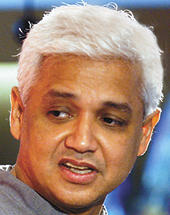
Amitav Ghosh

Amitav Ghosh was born in Calcutta in 1956. He grew up in Bangladesh (then East Pakistan), Sri Lanka, Iran and India. After graduating from the University of Delhi, he went to Oxford to study Social Anthropology and received a Master of Philosophy and a Ph. D in 1982. In 1980, he went to Egypt to do field work in the fellaheen village of Lataifa. The work he did there resulted in In an Antique Land (IAAL 1993). Ghosh has been a journalist and published his first novel, The Circle of Reason in 1986, and his second, The Shadow Lines, in 1988. Since then, he has published IAAL, The Calcutta Chromosome, and The Glass Palace, done fieldwork in Cambodia, lived in Delhi and written for a number of publications. He currently lives in New York and teaches at Columbia University.

Books by Ghosh:

> The Circle of Reason. New York: Viking, 1986. 423 pp.
Ghosh's first novel opens with the arrival of a child "Alu" ("potato"-- for the shape of his head) in a small village and is divided into three sections: "Satwa: Reason," "Rajas: Passion," and "Tamas: Death."

> The Shadow Lines. New York: Penguin, 1990. (First published in England by Bloomsbury Press, 1988) 246 pp.
His second novel focuses on the narrator's family in Calcutta and Dhaka and their connection with an English family in London.

> In an Antique Land. New York: Vintage, 1994. (First published in England by Granta Books, 1992) 393 pp.
The cover proclaims IAAL "History in the guise of a traveller's tale," and the multi-generic book moves back and forth between Ghosh's experience living in small villages and towns in the Nile Delta and his reconstruction of a Jewish trader and his slave's lives in the eleventh century from documents from the Cairo Geniza.

> The Calcutta Chromosome (Picador, 1996)
This novel has been described as "a kind of mystery thriller" (India Today). It brings together three searches: the first is that of an Egyptian clerk, Antar, working alone in a New York apartment in the early years of the twenty-first century to trace the adventures of L. Murugan, who disappeared in Calcutta in 1995; the second pertains to Murugan's obsession with the missing links in the history of malaria research; the third search is that of Urmila Roy, a journalist in Calcutta in 1995 who is researching the works of Phulboni, a writer who produced a strange cycle of "Lakhan stories" that he wrote in the 1930s but suppressed thereafter.

> The Glass Palace (Random, 2000)
In a review in The New York Times, Pankaj Mishra describes Ghosh as one of few postcolonial writers "to have expressed in his work a developing awareness of the aspirations, defeats and disappointments of colonized peoples as they figure out their place in the world." The novel is set primarily in Burma and India and catalogs the evolving history of those regions before and during the fraught years of the second world war and India's independence struggle.

Literature: Arundhati Roy


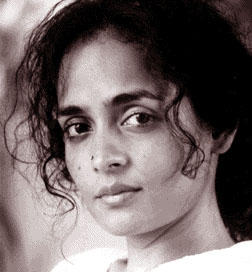
Arundhati Roy

Arundhati Roy (born November 24, 1961) is an Indian novelist and peace activist. She won the Booker Prize in 1997 for her first novel The God of Small Things.

Roy was born in Shillong, Meghalaya to a Keralite Syrian Christian mother and a Bengali Hindu father, a tea planter by profession. She spent her childhood in Aymanam, in Kerala, schooling in Corpus Christi. She left Kerala for Delhi at age 16, and embarked on a bohemian lifestyle, staying in a small hut with a tin roof within the walls of Delhi's Feroz shah Kotla and making a living selling empty bottles. She then proceeded to study architecture at the Delhi School of Architecture, where she met her first husband, the architect Gerard Da Cunha.

Arundhati met her second husband, Pradeep Kishen, a film-maker, in 1984, under whose influence she moved into films. She acted in the role of a village girl in the award-winning movie Massey Sahib, and wrote the screenplays for In Which Annie Gives it Those Ones and Electric Moon. She also wrote the screenplay for The 'Banyan Tree', a television serial.

Roy began writing The God of Small Things in 1992 and finished it in 1996. She received half-a-million pounds in advances, and rights to the book were sold in 21 countries. The book is semi-autobiographical and a major part captures her childhood experiences in Aymanam. Contrary to some assumptions, Roy is not a twin. This misinformation arose from the fact that the character of Rahel is based on herself. We see this in the physical description of the character in her adulthood and also by some of this character's interactions with her mother, Ammu.

In response to India's testing of nuclear weapons in Pokhran, Rajasthan, Roy wrote The End of Imagination, a critique of the Indian government's nuclear policies. It was published in her collection The Cost of Living, in which she also crusaded against India's massive hydroelectric dam projects in the central and western states of Maharashtra, Madhya Pradesh and Gujarat. She has since devoted herself solely to non-fiction and politics, publishing two more collections of essays as well as working for social causes.

In 2002, Roy was convicted of contempt of court by the Supreme Court in New Delhi for accusing the court of attempting to silence protests against the Narmada Dam Project, but she received only a symbolic sentence of one day in prison.

Roy was awarded the Sydney Peace Prize in May, 2004, for her work in social campaigns and advocacy of non-violence.

In early 2005, New Republic commentator Tom Frank sparked controversy with the comment, "Maybe sometimes you just want to be on the side of whoever is more likely to take a bunker buster to Arundhati Roy."

Literature: Monica Ali


Monica Ali

Monica Ali is the daughter of English and Bangladeshi parents. She came to England aged three years, her first home being Bolton in Greater Manchester, and later studied at Oxford University. Her first novel, Brick Lane (2003), is an epic saga about a Bangladeshi family living in the UK, and explores the British immigrant experience. It has been shortlisted for the 2003 Man Booker Prize for Fiction.


Monica Ali lives in London and was named in 2003 by Granta magazine as one of twenty 'Best of Young British Novelists'.

Prizes and awards:

2003 British Book Awards Literary Fiction Award (shortlist), Brick Lane
2003 British Book Awards Newcomer of the Year, Brick Lane
2003 Guardian First Book Award (shortlist), Brick Lane
2003 Man Booker Prize for Fiction (shortlist), Brick Lane
2003 WH Smith People's Choice Award, Brick Lane

Literature: Vikram Seth


Vikram Seth

A small, wiry soap opera enthusiast with well-defined features and a ready smile, Vikram Seth was born in Calcutta in 1952 (also the home of Indian literary giant Rabindranath Tagore). Throughout Seth's childhood, his father Prem Seth was a shoe company executive and his mother Laila Seth served as a judge (Bemrose). Vikram Seth is the oldest of three--his brother conducts Buddhist meditational tours and his youngest sister serves as an Austrian diplomat (Robinson, Rachlin).

After completing his primary education, Seth left India to study at Oxford University, England, earning a degree in philosophy, politics, and economics (a PPE degree). He further enrolled at Stanford University, intending to earn a PhD in Economics, but never completed his study. While at Stanford, Seth was also a also a Wallace Stegner Fellow in Creative Writing from 1977-1978. During a period from 1980-1982, he studied classical Chinese poetry and different languages at Nanjing University, China. Seth mentions that he "never had any passion for economics, not what I felt for writing poetry" (Robinson). But Seth does comment upon his failure to complete a PhD: "I feel a bit of regret that I didn't finish my Ph.D. I'm interested in it, but it's not a passion, the way writing is" (Rachlin).

Vikram Seth has published eight notable works - six collections of poetry and two novels - with a ninth novel soon to come. During the period before and after Seth published his first novel, he contributed poetic works for more than a decade. Seth's books of poetry include Mappings (1980), From Heaven Lake (1983), which discusses a hitchhiking trip through Nepal into India that Seth took while studying in China, The Humble Administrator's Garden (1985), All You Who Sleep Tonight (1990), Beastly Tales (1991), and Three Chinese Poets (1992). These works broach a variety of subjects indicative of Seth's education and experiences, evidenced in a passage from All You Who Sleep Tonight entitled "Sit" (Seth, 20):

Sit, drink your coffee here; your work can wait awhile. You're twenty-six, and still have some life ahead. No need for wit; just talk vacuities, and I'll Reciprocate in kind, or laugh at you instead.
The world is too opaque, distressing and profound. This twenty minutes' rendezvous will make my day: To sit here in the sun, with grackles all around, Staring with beady eyes, and you two feet away.

In 1986, Vikram Seth wrote The Golden Gate, his first novel, called "Byronesque" by some critics (Perry). The Golden Gate, which is a novel composed entirely of rhyming tentrameter sonnets--690 of them to be precise--is a satirical romance describing the stories of young professionals in San Francisco throughout their quests and questions to find, then deal with, love in their own lives as well as each others'. After this initial work, Seth slowly produced A Suitable Boy, the 1,349 page colossus whose publication in 1993 propelled Seth into the public spotlight.

In addition to Vikram Seth's literary and poetic achievements, he was commissioned by the English National Opera to write a libretto based on the Greek legend of Arion and the Dolphin. The opera was performed for the first time in June 1994. Orion Children's Books subsequently published a picture book based on the opera in which Vikram Seth's words are illustrated by the internationally acclaimed artist Jane Ray. The book has since been made into a twenty-five minute animated special entitled "Arion and the Dolphin" which has shown in Australia, Canada, Iceland, Malta, New Zealand, and throughout the United Kingdom.

Poems:

> Mappings (1980)
> The Humble Administrator's Garden (1985)
> All You Who Sleep Tonight (1990),
> Beastly Tales (1991)
> Three Chinese Poets (1992)

Novels:

> The Golden Gate - A Novel in Verse, 1986
> A Suitable Boy, 1993
> An Equal Music, 1999
> Two Lives, 2005

Literature: Jhumpa Lahiri


Jhumpa Lahiri

In 1967, Jhumpa Lahiri was born in London to Bengali parents.As a child, Lahiri moved with her family to Rhode Island where Jhumpa spent her adolescence. Lahiri went on to attend Barnard College, graduating with a Bachelor of Arts in English and later attending Boston University. It was here Lahiri attained Master's Degrees in English, Creative Writing, and Comparative Studies in Literature and the Arts as well as a Ph D in Renaissance Studies. Lahiri also worked for a short time teaching creative writing at Boston University and the Rhode Island School of Design.

Lahiri has traveled extensively to India and has experienced the effects of colonialism there as well as experienced the issues of the diaspora as it exists. She feels strong ties to her parents' homeland as well as the United States and England. Growing up with ties to all three countries created in Lahiri a sense of homelessness and an inability to feel accepted. Lahiri explains this as an inheritance of her parents' ties to India, "It's hard to have parents who consider another place "home"-even after living abroad for 30 years, India is home for them. We were always looking back so I never felt fully at home here. There's nobody in this whole country that we're related to. India was different-our extended family offered real connections." Yet her familial ties to India were not enough to make India "home" for Lahiri, "I didn't grow up there, I wasn't a part of things. We visited often but we didn't have a home. We were clutching at a world that was never fully with us" (Interview with Vibhuti Patel in Newsweek International, 9-20-99).

Lahiri, the daughter of a librarian and school teacher, has always been inclined to creative writing. Lahiri remembers a need to write as early as ten years old and she has always used writing as an outlet for her emotions, "When I learned to read, I felt the need to copy. I started writing ten page 'novels' during recess with my friends' writing allowed me to observe and make sense of things without having to participate. I didn't belong. I looked different and felt like an outsider" (Interview with Vibhuti Patel in Newsweek International, 9-20-99).

At a press conference in Calcutta in January of 2001, Lahiri described this absence of belonging, "No country is my motherland. I always find myself in exile in whichever country I travel to, that's why I was tempted to write something about those living their lives in exile". This idea of exile runs consistently throughout Lahiri's Pulitzer Prize winning book Interpreter of Maladies.

The book brings to light many of the issues with identity faced by the Diaspora community. The book contains the stories of first and second generation Indian immigrants, as well as a few stories involving ideas of otherness among communities in India. The stories revolve around the difficulties of relationships, communication and a loss of identity for those in diaspora. No matter where the story takes place, the characters struggle with the same feelings of exile and the struggle between the two worlds by which they are torn. The stories deal with the always shifting lines between gender, sexuality, and social status within a diaspora. Whether the character be a homeless woman from India or an Indian male student in the United States, all the characters display the effects of displacement in a diaspora.

Lahiri has won many awards for Interpreter of Maladies. These awards and honors include The Pulitzer Prize in 2000, The Transatlantic Review Award from the Henfield Foundation, The Louisiana Review Award for Short Fiction, the O. Henry Award for Best American Short Stories, the PEN/Hemingway Award, The New Yorker Debut ofthe Year Award and The American Academy of Arts and Letters Award. Lahiri also received a nomination for the LA Times Book prize as well as the Guggenheim Fellowship in 2002. She has published three stories in The New Yorker, as well as published works in the Agni, Epoch, The Louisville Review, Harvard Review and the Story Quarterly. Lahiri is currently living in New York with her husband and son. Lahiri released her first novel in September of 2003. The novel is titled The Namesake and it follows the trials of a newlywed couple who immigrate to Cambridge, Massachusetts, from Calcutta.

Works:

> The Namesake (2003)
> India Holy Song (2000)
> Interpreter of Maladies (1999)
> "A Temporary Prayer: What Happens when the Lights go out." The New Yorker 20 April 1998
> "Sexy." The New Yorker 28 Dec 1998
> "The Third and Final Continent." The New Yorker 21 May 1999